
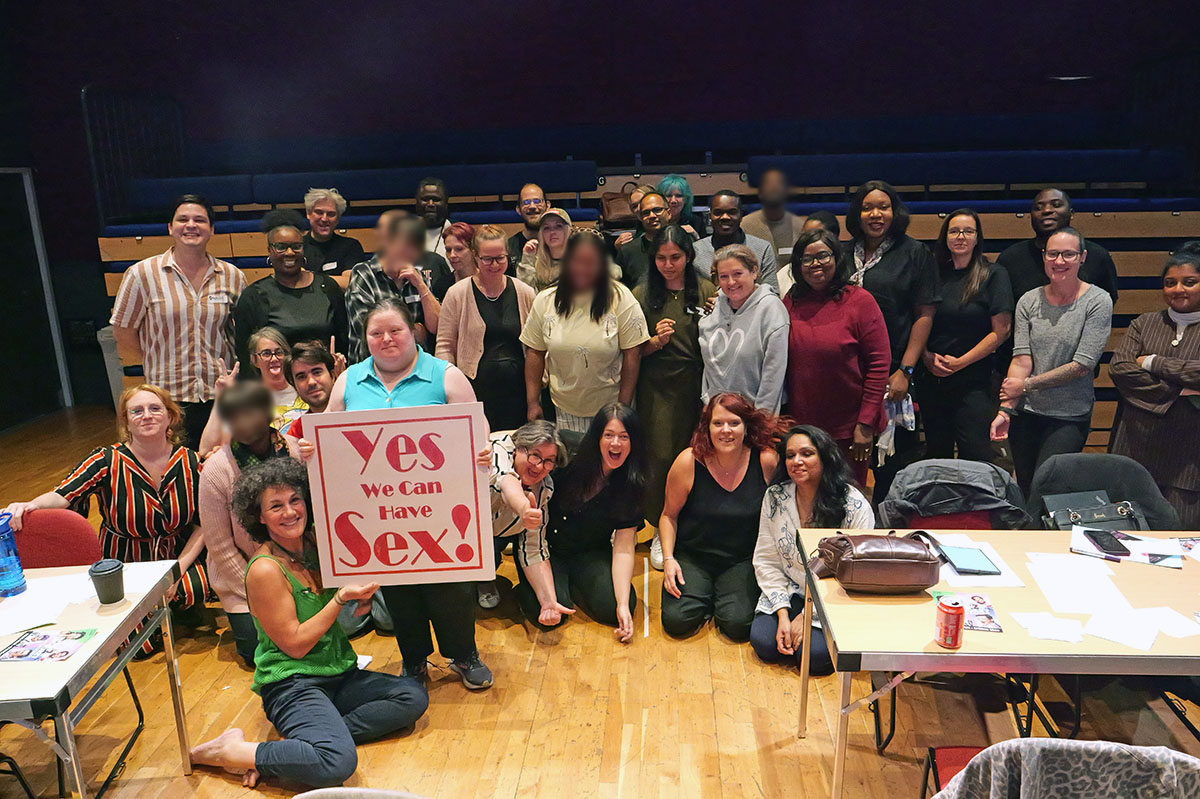
On 17 September, we welcomed around 30 managers, team leaders and support staff from Salutem Care and Education (providing approximately 200 care and support services including SEN schools, day and residential centres for children and adults in the UK) to the Studio Theatre at The Source, Stratford, for Naming It Isn’t Breaking It!
This was a pilot training workshop developed by Not Your Circus Dog! with Salutem. It was our second session together, following a screening and discussion of NFS! The Film at Salutem’s conference in June.
Liselle Terret, Stephanie Newman, Marc Ramoneda Moreno and Christine Howland from Salutem facilitated the workshop. Creative Support Worker Heather Johnson and production manager Adam Moffat-Seaman supported them. The day was built around extracts from the award-winning disability-led theatre production Not F**kin’ Sorry! (NFS!), developed by Not Your Circus Dog! (co-produced by Доступ ко всем областям). It explored identity, communication, dignity, autonomy, sex, intimacy, relationships, risk and power in everyday service life, and what gets in the way of change.
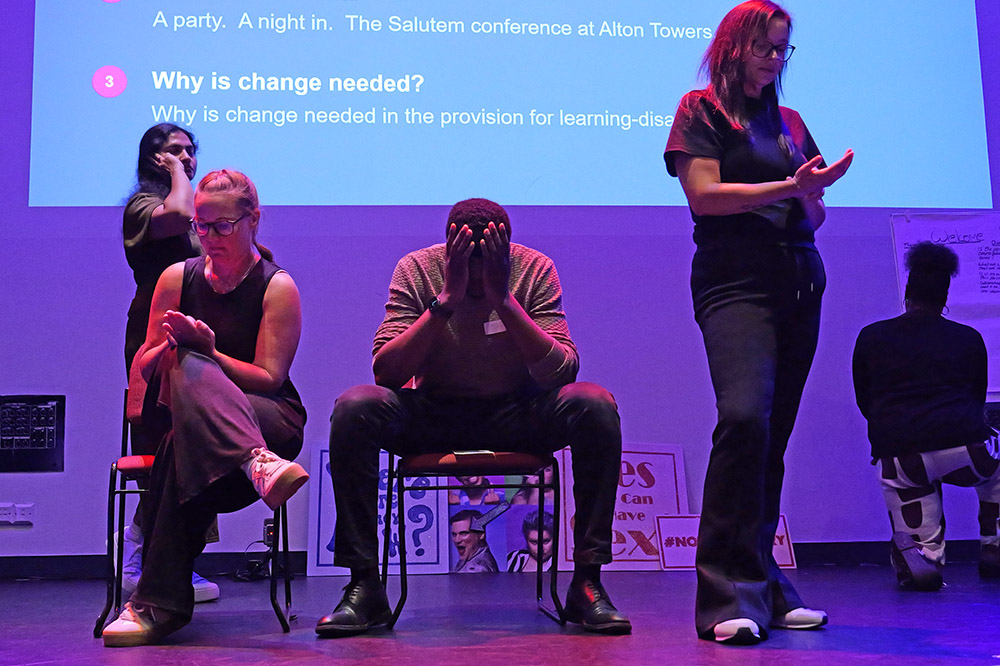
One question ran through the afternoon: “When does understandable fear become avoidance, and who experiences the consequences?” Participants mapped barriers on the wall from five perspectives: the organisation, staff teams, the person supported, families, and legislation and policy. Asked why change is needed, they wrote “being talked for” and “the service user doesn’t feel heard”. In the voice of the people they support, they also asked: “Why am I not involved in my own choices?”
Performance was at the heart of the day. After a warm-up led by Stephanie, groups responded to the film extracts A busload of cutsie Disabled People и Where Are They Now? by making frozen pictures, or tableaux: conversations through the body.
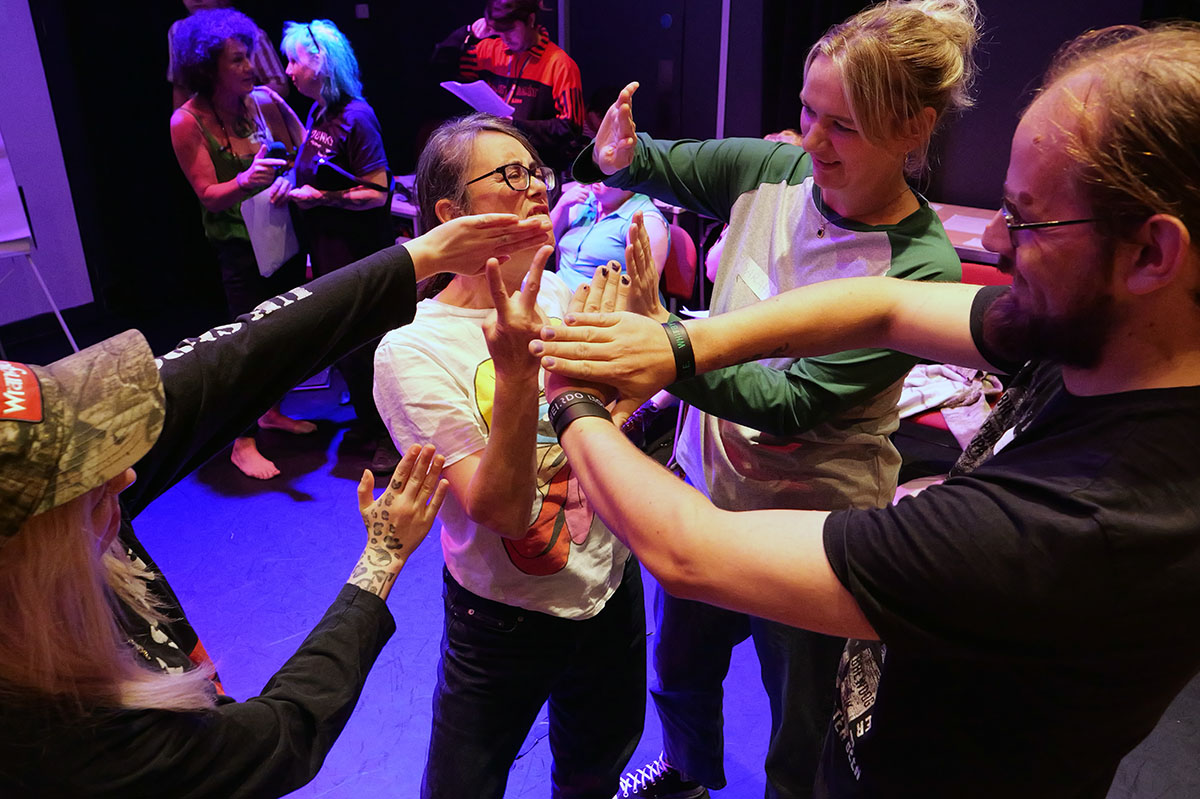
In a short scene, “The Answer Is Always No”, the usual roles were reversed. Stephanie played a day-centre support worker. Liselle played Rose, a learning disabled woman asking to go for a walk with someone she had recently met.
A section on power and intersectionality asked who is present, absent, spoken for or allowed to decide. Small groups then worked through realistic scenarios, from a question about masturbation met with embarrassment to infantilising language in a handover. Each group added identity and context cards such as faith, sexuality or communication method. “Did you know…?” facts spread out across the session kept things grounded, including the Care Quality Commission’s reminder that “sexual expression is a positive, natural human need”. Finally, each participant named one barrier within their own influence and turned it into an action plan.
The responses were thoughtful and generous. One participant wrote:
The performance always gets into the mind quickly, policy briefing I know is important but boring… performance we all get to participate.
Another reflected:
Today felt more inclusive as people who may not necessarily voice their opinion were able to watch, process, reflect, speak and be heard without limitation or judgement.
Being co-led by a learning disabled artist mattered:
I love that the individual was able to tell us their point of view, their lived experience and their joy.
Another noticed that
Liselle was uplifting Stephanie and vice versa, and Stephanie had no trouble telling Liselle when it was her time to speak!
For someone else it came down to:
Real life. Real impact.
The day was not always comfortable, and it was not meant to be. Participants described feeling “challenged but positive”. One recognised that some barriers are “very much existent in our everyday practices although inadvertently still there. It leaves us to question how we change this and who we need to support us to do so.” Naming it isn’t breaking it.
The commitments people made were concrete:
- reviewing how involved people are in the sexuality and relationships sections of their own care plans
- raising the topic at team meetings
- challenging barriers in the moment
- making sure the people they support know staff are there “should they want to discuss it”
As one participant put it: “No bystanders.”
The workshop was evaluated through pre- and post-workshop questionnaires as part of Marc’s funded PhD at UEL. The PhD is co-developing and evaluating a learning-disabled-led training toolkit on intimacy, relationships and sexual rights.
Of the 23 participants who consented to their post-workshop answers being used:
- 22 would recommend the training to a colleague
- 22 agreed that the performance and drama-based parts were an effective way to explore these issues in professional training (18 strongly agreed)
- looking back, they rated themselves at 3.4 out of 5 on average for noticing how a person’s identity, communication and power can shape a situation before the session, and 4.5 after it
- 18 said they were likely or very likely, within the next month, to start a conversation with someone they support about privacy, friendship, intimacy, relationships, consent or their hopes
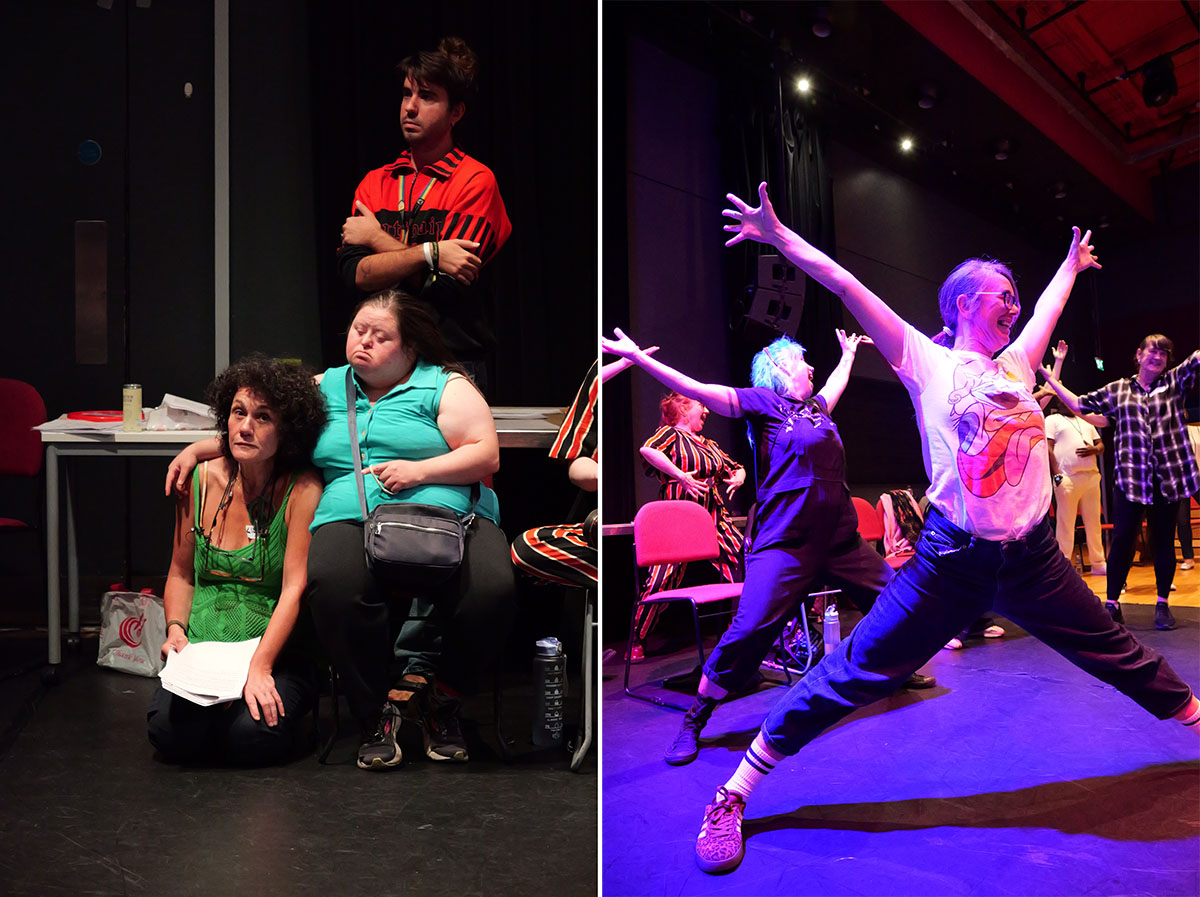
Participants also gave us clear pointers for next time, including fewer papers on the tables and more time to think during group work. The work is not finished. We will follow up with Salutem on the action plans, and what we learn will shape the next version of the training. As one participant wrote:
If the pathway is easy, you’re on the wrong path.
Key Themes Explored
- Relationships, sexuality, intimacy and rights
- Privacy, autonomy and choice
- Fear, avoidance and risk aversion
- Power, intersectionality and who gets to decide
- Language, dignity and organisational culture
- Disability-led performance as pedagogy
- Turning reflection into sustainable action
A huge thank you to:
- Salutem, and especially Christine Howland, for their commitment to this partnership
- Stephanie Newman for her brilliant co-facilitation
- Heather Johnson for her support throughout the day
- Adam Moffat-Seaman for production and photography
- the team at The Source
- every participant, for their openness
- Photos: Adam Moffat-Seaman
Marc Ramoneda Moreno, PhD Researcher, University of East London